
On a Tuesday night in mid-February, more than a dozen downtown St. Louis residents sat in a circle on wooden chairs in an event space on Washington Avenue and 10th Street, debating the future of their neighborhood.
ÁñÁ«ÊÓƵ were there to hash out a conflict between late-night sidewalk food vendors and neighborhood organizers who think the vendors are too late-night. It got contentious. And it got to be about more than just hot dogs.
The neighborhood organizers want the city to enforce a long-ignored statute imposing an 11 p.m. curfew on the vendors, who have been allowed for years to sell as late as 3 a.m. The vendors want the city to change the statute and let them continue doing what they’ve been doing.
“You would be hurting downtown� by enforcing the statute, vendor Bobby Costello told the neighborhood organizers. “You’re literally taking a food option away from residents and people who are visiting downtown. That is the dumbest thing ever.�
People are also reading…
One of the organizers, Dan Pistor, countered that wee-hours foot traffic and nightlife along Washington Avenue isn’t a universally supported goal of neighborhood residents. In recent years, and especially post-COVID, the area has morphed from an entertainment district into a more residential enclave.
Said Pistor: “There’s a lot of other people downtown that want a more quiet — �
“Then move to Webster,� Costello interrupted. “This is downtown St. Louis.�

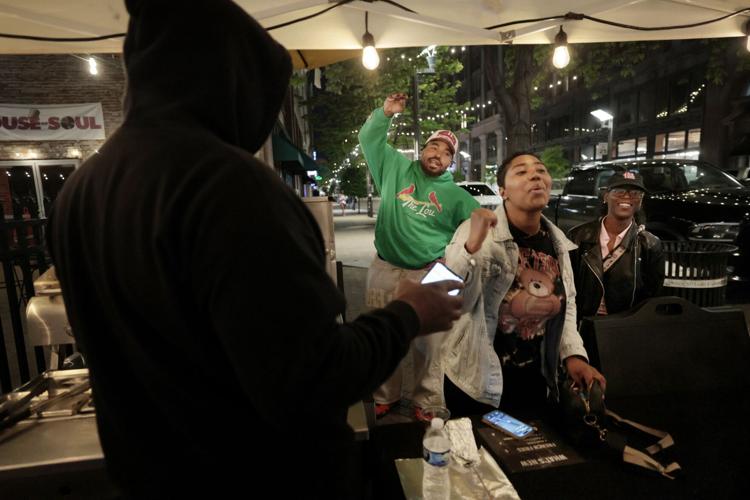
Demarcus Brown, background, waits behind Kealy Franklin to place his food order with Overtime Grill cartÌýco-owner Troy McAdoo, just after midnight on Sunday, April 19, 2026, at Tucker and Washington in downtown St. Louis. “The food is the right price. It’s good. It’s fresh,â€� said Brown, who frequents the vendors.
That dynamic — residents united in their desire to re-imagine and revive the city's core but divided over how to do it — could describe the wider debate over the future of downtown.
The Post-Dispatch Editorial Board has been talking since late last year with developers, city officials, residents and others, with one big question: What can be done to revive downtown St. Louis?
In the days to come, we will publish a series of editorials exploring the problems and competing solutions. We will bring in varied voices to talk about ideas for addressing key challenges, including crime, infrastructure, business climate and the national reputation of the city's downtown. We are keeping the editorials in the series outside our paywall, free to everyone, to include as many community members in the conversation as possible.
In St. Louis, "downtown" is generally shorthand for the combined central core and Downtown West neighborhoodÌý—Ìýbordered by the Mississippi River on the east, Jefferson Avenue on the west, Chouteau Avenue on the south and just beyond Washington Avenue on the north.
That’s well over 2 square miles — roughly twice the geographic size of, say, downtown Detroit. That big footprint is left over from an era when St. Louis was home to almost three times as many people as it is now.
So why this overriding focus on reviving this one neighborhood when there are so many other areas that are struggling as much or more, including large swaths of north city after last May's tornado?
Because the downtown/Downtown West corridor isn’t just another of St. Louis’ distinct neighborhoods. It is theÌýarea that defines our city to the region and to the nation — the one area without which St. Louis wouldn’t be St. Louis.
Even with its current troubles, downtown St. Louis is our city's primary economic driver, the base for more than 2,000 business and government employers. It is our sports and tourism sectors, home to four professional sports teams and one of America’s greatest monuments. It is, to use a familiar cliche that happens to be true, St. Louis’ doorstep to the world. It is also the city's biggest jobs and money engine. A struggling downtown hurts all neighborhoods.
"When I look at cities that are succeedingÌý—Ìý, for example — they really jump-started their revitalization efforts by focusing on their downtown," Mayor Cara Spencer told us. "You have to have a critical mass and that does start with a downtown."
And our downtown is crumbling.

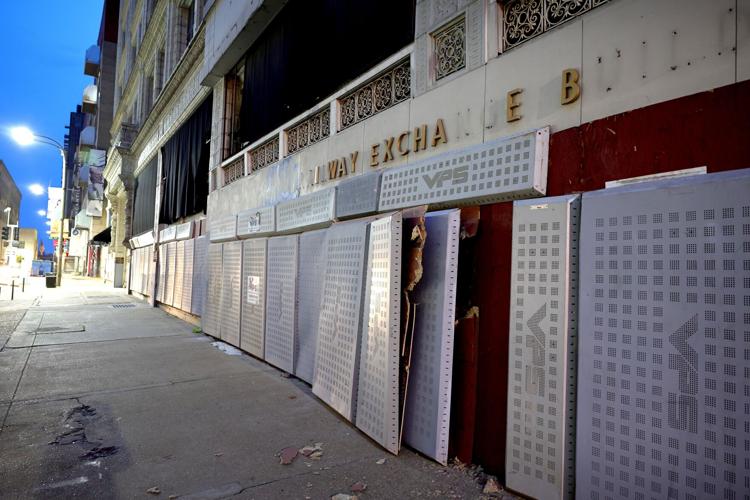
Metal security panels that were pulled down by vandals rest outside the Railway Exchange building in downtown St. Louis on Friday, April 3, 2026.
As recently as 2011, a decade after a major push for downtown revival by civic, business and government interests, Washington Avenue was named one of America’s top 10 "great streets" by the .
Today, the neighborhood boasts isolated islands of activity — clusters of bars and restaurants, groupings of offices and residential lofts, sports and entertainment venues — but all scattered and separated by block after block of vacant storefronts, unoccupied apartments and empty sidewalks.
All that ghostly space is a big part of the problem.
It might also contain some solutions.
What we’ve heard repeatedly is determination from genuinely dedicated citizens who share an obsession with fostering a Detroit-like urban renaissance here. But there's almost no overarching consensus on how to do that.
As we address those and other issues in the coming days, we’ll be asking readers to weigh in — not just downtown residents, but citizens throughout the St. Louis region. Among the goals of this series will be to make the case that, however you feel about late-night hot dogs, reviving our once-great downtown is everyone’s business.
The 'doughnut hole'
Downtown has long been derided as the city’s “doughnut hole.� There’s stuff around the edges, but nothing in the middle.
Still, a surface inventory of what actually is in St. Louis’ downtown corridor might make it sound more like a vibrant metropolitan feast.
We’re anchored on the east by one of the world’s most recognizable monuments, the Gateway Arch. Modern skyscrapers and hotels near the river give way to acres of architecturally fascinating 19th- and early-20th century brick buildings along the Washington Avenue Loft District — sleek condos peeking out from Gothic stone. The America’s Center Convention Complex draws between 600,000 and more than 1 million visitors annually from all over the world.
Busch Stadium, Enterprise Center, Stifel Theatre and St. Louis City SC attract sports and entertainment crowds so bustling that they require regularly closing streets. Citygarden, the three-acre sculpture park, and CityMuseum, the quirky rooftop carnival, are inspired examples of urban art-as-infrastructure.
The shell of Union Station — where President Harry Truman gloatingly displayed the erroneous Chicago Tribune headline “Dewey Defeats Truman� from a train platform in 1948 — now houses a 120,000-square-foot aquarium boasting 13,000 marine occupants. The central branch of the library system, a 1912 Beaux-Arts behemoth that underwent a lavish 2012 restoration, is among the most stunning Carnegie libraries in the world. City Hall on Market Street, modeled after Paris’ City Hall, is a tribute to St. Louis’ historical French legacy.

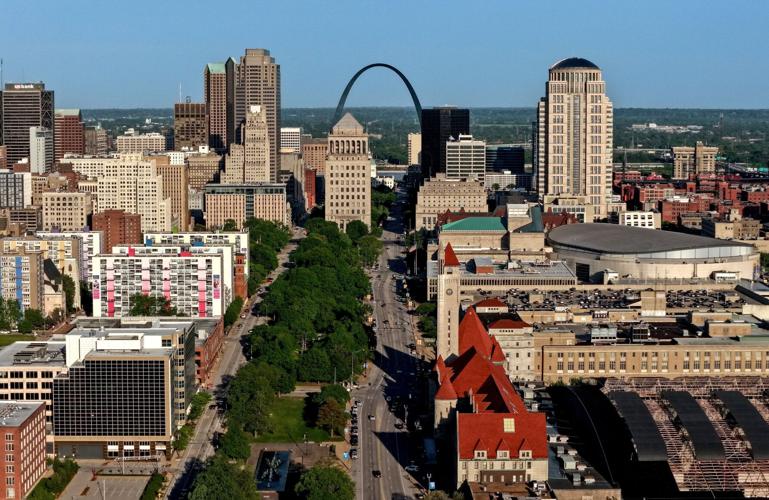
A view of Union Station, the Gateway Arch, and the downtown and Downtown West neighborhoods of St. Louis is seen from the 2200 block of Market Street on Thursday, April 16, 2026.
If downtown St. Louis were a house, it might be said to have great bones.
But it might also be said to be largely vacant and in desperate need of rescue.
The tallest of those east-side skyscrapers, AT&T tower, has essentially been a 44-story paperweight since the last tenant moved out in 2017. The sprawling Millennium Hotel complex, perched right over the river, was shuttered three years earlier. For almost two years, until last summer, City Hall had metal barricades surrounding its lawns to prevent the unhoused from camping there.
Block after block of those gorgeous century-old brick buildings face Washington Avenue with vacant and sometimes boarded-up storefronts. The 1.2-million-square-foot Railway Exchange Building, an homage to the era when department stores like Famous-Barr anchored America’s downtowns, has been vacant and beset by vandalism and decay. The Convention Center’s adjacent dome stands as a mocking reminder that the NFL abandoned St. Louis a decade ago.
“Downtown is not one thing. It has poverty and high net worth and aging infrastructure. It’s our region in a nutshell,� developer Alex Oliver told us.
The question today, he says, is whether “the car is in gear, versus the car is stalled.�
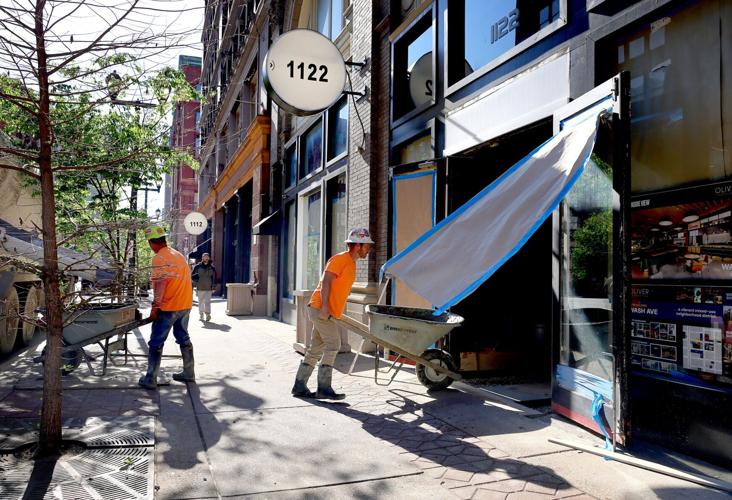
His company, Oliver Properties, is betting on the former, developing downtown real estate for more than a decade. Its portfolio includes many of those historic buildings along Washington, former textile and shoe manufacturing centers and warehouses now retrofitted as urban lofts. His company is currently a $6 million food hall on Washington near 11th Street.

Josh Whitener, left, and Cody Newton bring wheelbarrows full of concrete into what will be the Wash Ave Food Hall in the 1100 block of Washington Avenue in dowtown St. Louis on Monday, April 20, 2026. The food hall is scheduled to open later in 2026.
But many other investors have pulled back in recent years amid wave after wave of disincentives: a housing crisis that complicated the area’s already tricky real estate market; the civil unrest and negative national attention after the 2014 police killing of Michael Brown in nearby Ferguson; COVID’s decimation of office culture; years of ineffective political leadership; and a lack of regional cohesion.
Perhaps most of all, there's a street-level environment downtown that too often feels like it has just two speeds: comatose or chaotic. "Boring and unsafe" was how the strip was described to the Boston-based Goldman Group when it surveyed city residents as part of its pending project to redevelop the AT&T building, as reported by .
No one who cares about downtown St. Louis could have been happy when dropped a devastating piece in April 2024, singling out our city as home to arguably the worst example of a downtown “doom loop� of disinvestment in America. Yet no one who has watched the area’s struggles in the past decade could seriously have claimed to be surprised.
Still — and this is the part we hope our skeptical neighbors who avoid downtown like the plague will hear — there’s a much more optimistic story that gets buried by stubborn perceptions that don’t match reality. And those misperceptions are driven largely by St. Louisans themselves.
Perception vs. reality
“We’ve got to do as good a job telling St. Louisans about what's happening in St. Louis as we are telling the rest of the world why this is such a great place to visit or meet,� says Brad Dean, president and CEO of Explore St. Louis, which operates America's Center Convention Complex and promotes tourism. “I would argue that the local St. Louisans and people in the region are maybe the biggest challenge.�
Consider the widely held perceptions about downtown St. Louis among our local and regional neighbors, versus the actual data:
• Violent crime is rampant and it’s not safe to visit.
While traffic scofflaws, car break-ins and the like remain a problem, violent crimes like murder, sexual assault, robbery have dropped dramatically downtown in the past few years.
Even in comparison to the citywide reduction in crime recently (violent crime was down 16% last year compared to the previous year; shootings were down 28%; homicides are at their lowest rate here since 2013), the city's core has done better. That's especially true regarding homicides, which totaled just one for the entire downtown/Downtown West corridor in 2025.
• Hardly anyone lives there.
St. Louis’ combined downtown/Downtown West corridor is home to between 10,000 and 11,000 residents — about 3,000 more than live in the most comparable business area of downtown Detroit.
Downtown St. Louis’ huge geographic footprint does mean there’s less population density here, which contributes to that feeling of emptiness in much of the area.
But the neighborhood’s population skyrocketed during a redevelopment push that started a quarter-century ago. The 2000 Census showed 3,010 residents living in the area, compared to 10,557 as of the . This came as the city’s overall population was plummeting.

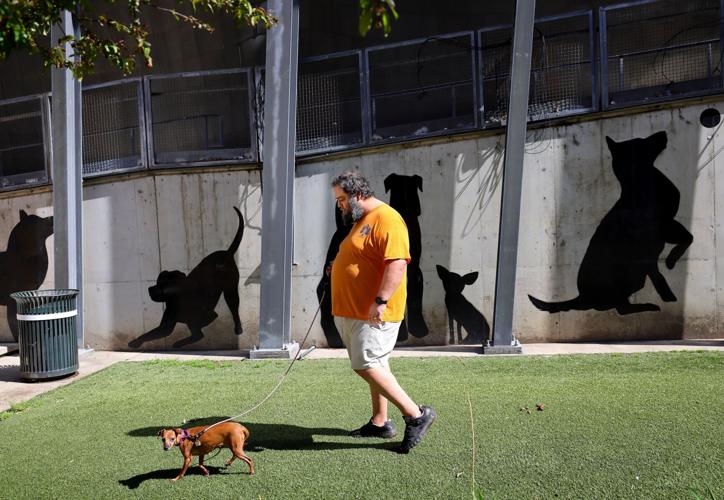
Downtown resident Brian Coffman walks his dog Ellie May in Old Post Office Plaza in St. Louis on Thursday, April 16, 2026. “I always wanted to live in a big city,� said Coffman, who rents an apartment in The Shelby but grew up in northwest Arkansas. Coffman says both he and wife feel safe downtown and that he “never imagined how much courteousness and kindness people show. It blows me away."
• No one is building or renovating there.
That’s the opposite of true. In addition to the aforementioned projects by Oliver Properties, other big projects underway include the renovation of the long-shuttered Jefferson Arms on Tucker near Washington, the renovation of the Millennium Hotel on the riverfront and major rehabs in buildings around the new soccer stadium on Market Street, among others.
In all, reports the , more than $1 billion worth of downtown projects broke ground or were announced in 2025.
• Downtown isn’t an important part of the city’s economy.
In fact, of the city’s roughly 80 neighborhoods, downtown/Downtown West is the single most important economic driver for St. Louis, contributing about 64,000 jobs, or more than one-fourth of the total number of city jobs, generating $4 billion in annual wages.
Downtown generates around $100 million in city tax revenue annually — or close to 20% of the city’s entire general revenue fundingÌý— while receiving just $26 million, or about 8%, of city expenditures, according to a 2022 study by Greater St. Louis Inc.
Dean, the Explore St. Louis CEO tasked with selling our city to the world, has plenty to work with.
He is a St. Louis newcomer, arriving last year after leading marketing for Puerto Rico and the Myrtle Beach area. “Being new to St. Louis, and also living downtown, maybe I come off a little bit of a pollyanna,� he told us. “But this region is just too good not to be great. There’s too much here.�
But he also knows he has plenty of work to do, especially when it comes to convincing St. Louisans of the value of their own city core.
That’s the same conclusion reached in a study that Explore St. Louis released in December, based on surveys, interviews and focus groups with downtown businesspeople, residents, political leaders and others.Ìý
"St. Louisans Named Locals as St. Louis’s Biggest Critics," announces a section of the report.
“Stakeholders repeatedly told us that the biggest detractors of St. Louis are its own residents,� states the study, which was conducted by Coraggio Group consultants. “They express frustration that those who should be the biggest supporters are often the ones saying the most negative things about the destination.�
Building support for a downtown revival will only become more complicated as the city works to recover from last year's tornado — a tragedy that, among its many other ramifications, pits neighborhoods against each other in the jockeying for city funds.Ìý
Spencer, though, presents what we would argue is a well-balanced assessment of the issue. In short, it doesn't have to be one or the other.
"We're prioritizing, as well we should be, investing in north St. Louis and the area impacted by the tornado. We need those neighborhoods to be successful for our city to be successful," the mayor said. "But in order for those neighborhoods to be successful, we have to have a successful downtown core."
‘A difference of opinion’
At the February meeting between street vendors and community organizers, another conflict was on display. Even those who understand the imperative of reviving downtown are often at odds about what that should look like.
Matt O’Leary, executive director for Downtown Forward, told the group his organization wants a quieter, more residential atmosphere.
“There is a difference of opinion amongst the various stakeholders down here,� O’Leary said, as some of the vendors’ supporters shook their heads. “At the end of the day, we have to listen not just to residents but to business owners, hotel owners, property owners. So that is a conversation we have to have.�
Bill Shelton, co-owner of Left Field Creative, a marketing firm, was among the head-shakers.
“There’s nothing better than eating a pretzel on the street in Philadelphia, or … (the) sausage vendors outside of Fenway Parkâ€� in Boston, Shelton said. “That’s a vital part of what people come to see. They can’t experience that in Evansville, Indiana, or Peoria, Illinois, or Springfield, Missouri, or somewhere in the cornfields of Iowa. It’s part of the texture and part of the cultureâ€� of an urban downtown.Ìý
Reconciling those and other competing visions for downtown must be part of the blueprint for its revival.
The stakes go beyond the neighborhood's borders.Ìý
As Mayor Spencer aptly puts it: "One of the main things that's been missing is a recognition of how important our downtown is to the success or failure of our state and our broader region."
This series was conceived, and its subjects interviewed, by the Post-Dispatch Editorial Board: Editorial Page Editor Kevin McDermott, Post-Dispatch Publisher Ian Caso, and community board members Antonio French, Janet Y. Jackson and Lynn Schmidt. It was researched and written by McDermott.
View life in St. Louis through the Post-Dispatch photographers' lenses. Video edited by Jenna Jones.